Showing posts with label jrpg. Show all posts

Thursday, June 13, 2019

Game Review: Tales of Berseria (PS4)

Tales of Berseria is both the bleakest and most uplifting game in the Tales series. The game hews to many traditional JRPG elements, including ridiculous outfits, random treasure chests, comic relief character, surprise villain, and thematic devices delivered with the subtlety of a sledgehammer. But Berseria is also unrelentingly dark, with a protagonist who teeters constantly on the brink of true villainy. Overall, Velvet's sheer drive and charisma overpower the weaker gameplay elements, and elevates Tales of Berseria as a giant among other Tales games.

Berseria takes place in a world beset by monsters that were once human. Only spirit creatures called malaks can vanquish them, and exorcists are the trained elite who use malaks as mindless weapons to fight against the scourge. Our main character is Velvet Crowe, a young woman traumatized by betrayal and loss, and sporting a demonic left arm that can consume anything. Imprisoned in solitary and fed monsters for three years, Velvet is released by a malak who serves the man she has sworn revenge against: the Abbey's Shepherd, Artorius, leader of the exorcists and Velvet's brother-in-law. Velvet gathers allies in her all-consuming quest, and together they travel across the oceans--in comically low-tech animation sequences--to achieve their terrible goal.

Story-wise, Tales of Berseria is compelling because it's firmly in the gray area. All the NPCs think Velvet and her group are the bad guys, because they specifically want to destroy humanity's best defense against monsters, for their own selfish reasons. And all the playable characters know it; they just don't care how they're labeled, because a major theme of the game is being true to yourself. Here is a helpful diagram detailing the characters and their motivations:


Velvet is on a roaring rampage of revenge; the demon swordsman Rokurou just wants to kill his older brother, a high-ranking officer in the Abbey; Eizen the pirate malak is looking for his ship's captain, abducted by the Abbey; Laphicet the malak wants to be a person, not a tool; and Eleanor the exorcist is obeying orders to infiltrate the group. And Magilou, dear Magilou, easily the best among the bunch: a powerful, older-than-she-looks witch who frequently points out the group's darkest truths and then immediately ducks behind a facade of laughing indifference. Together, this team leaves a trail of destruction in their wake, led by the implacable Velvet. They're so the bad guys.

The story, with its multiple twists, the deeply sympathetic characters, and the strong voice acting and soundtrack helped me overlook the unimpressive combat system and sad dungeon designs. In terms of combat, fighting with Velvet and co. basically consists of button-mashing. Characters learn Artes, or special moves, that can be assigned to specific buttons, so a keener player would probably excel at executing combos and blocking and whatnot, but impatient players who skip right past densely-worded tutorials must button-mash and hope for the best. Hey, worked for me! On normal mode, victory earns players all sorts of stuff, such as armor and bonus-granting items. I never had to buy anything from stores, and always had materials on hand to enhance my weapons and equipment, so that's a plus.

Meanwhile, the way the story progresses is laughable. Let's just say that the road to revenge has many detours, during which, of course, the characters learn some important background about something or someone that helps them move forward. But perhaps the worst part about all the gallivanting are the dungeons, which are so badly designed that rooms are almost indistinguishable from each other, and cannot be traversed successfully without the mini-map.

Another meh feature in Tales of Berseria are the side quests, which can easily be missed by the inattentive. I ended up doing most of them during the end game, because that's when I noticed that they existed. Yeeks. Players can also send out their ship on brief expeditions to uncover treasures and rare items. And then, naturally, there's cooking and finding recipes. All these little asides are worth it for completionists, of course, but they're...meh.

In conclusion, Berseria's unrelenting grimness is regularly broken by the highly entertaining skits that are a hallmark of the Tales series, so it's not all a howling wilderness of agony and vengeance. As she comes closer to her goal, it becomes clear that Velvet's desire for revenge is so deep because it came from her love, which was endless, especially for her family. And Tales of Berseria ends in a way that honors the pain she endured, the sacrifices she made, the horrors she inflicted, and most of all, the love that was her true strength all along.

TL;DR: Great protagonist, fun characters, and moving story make up for the okay gameplay. Highly recommended!

---

This post brought to you by Nespresso!

Wednesday, November 28, 2018

Game Review: Xenoblade Chronicles 2 (Switch)

Xenoblade Chronicles 2 (XC2) is a massive JRPG that outdoes its sprawling predecessor by adding more, more, more! While it has its share of flaws, XC2 offers so many delights that it's already absorbed 150+ hours of my free time. To put that into context, I usually take 80 hours to 100% complete a JRPG. To quote from Brokeback Mountain: "I wish I could quit yew."

Briefly, XC2 tells the story of Rex and Pyra and their quest to reach Elysium, a paradise in the sky. Rex is an earnest young salvager who conscientiously sends his earnings back home, while Pyra is a mild-mannered and sweet-tempered "Blade," or living weapon, which can be wielded by a "Driver." During their journey, the pair encounter various colorful playable and non-playable characters, formidable monsters, and a group called Torna that wants Pyra's power for its own destructive goals.

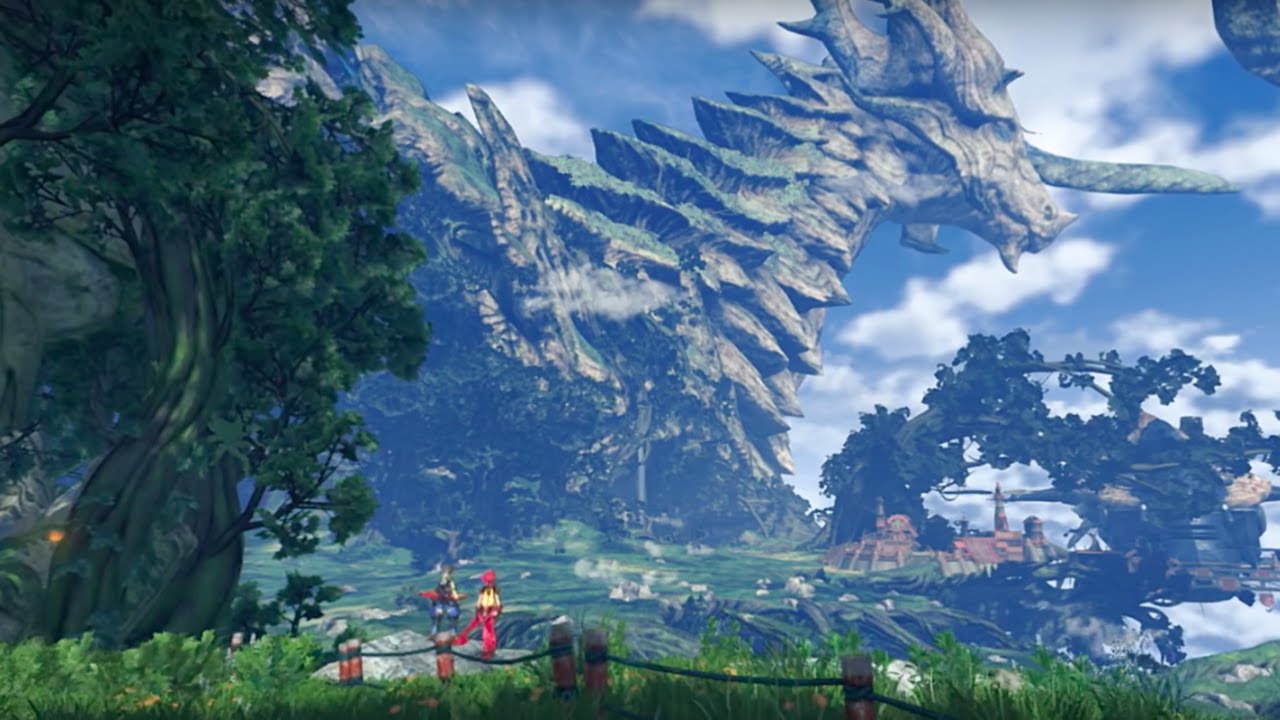
Like the first Xenoblade Chronicles, XC2 achieves epic scale through, well, scale: the game takes place on a world called Alrest, which consists of the "Cloud Sea" and continent-sized Titans that house all living organisms, including humans, etc. Running around on a giant being while essentially being a microbe evokes a feeling of wonder, an impression helped immensely by the game's outstanding visuals. Of course, the story is appropriately grand, with the world itself at stake, as usual. What starts out as a rather obvious allegory for climate change and humanity's decline becomes an examination of existence.

Image from gamingbolt.com

Of course, love and friendship make every journey worthwhile, and here XC2 performs very well. Every character is my favorite; I simply can't choose one! The playable characters all have an arc and demonstrate a broad range of emotions and reactions. For example, Rex goes from determined to self-doubting to implacable, while Nia learns to trust, without ever losing her signature snark. Meanwhile, their Blades are loyal, loving, and absolute beasts on the battlefield. And the villains are equally engaging, with motivations and histories that turn them into complex, nuanced, and even tragic figures.

But the best part of XC2 is unquestionably its soundtrack. The musical styles run the gamut: hard rock spurs combat; operatic swoops underscore majestic vistas, slapstick twangs mark humorous interactions; and more! I particularly like "Counterattack" and "Kingdom of Tantal (Day)," but the rest of the OST is so good that I don't mind listening to it on repeat. Kudos to Yasunori Mitsuda, et al for yet another excellent body of work.

The tracks perfectly accompany the fabulous cut scenes, which feature a lot of outstanding fight choreography. The voice acting is top-notch, of course, although I can only speak for the Japanese track, which I switched to early on. I did like the UK accents that I heard before the switch!

Now let's talk about some questionable decisions the developers made. The internet is rife with grumbling about the bloated gameplay (here's one example, from Kotaku). Indeed, XC2 is...very extra. This becomes glaringly apparent during combat and sidequests. In combat, there are Driver combos, Blade combos, Fusion combos, Specials, chain attacks, etc., and while players can master these with practice, the absolutely terrible camera angles ruin the fun. I've gone through countless battles where I deliver a devastating blow, and the camera inexplicably focuses on someone's feet or legs. Why? Why?

The aftermath of combat is also a hot mess. Defeating enemies causes money or items to drop, and players have to run around scooping them up. But! If the enemy is, say, an aerial creature that has to be fought over a cliff, say goodbye to your prizes! Rrrrgh! To say nothing of salvaging rare treasure chests, only to lose your chance to open them because an enemy five levels higher got pulled up too. Kyaaaa!

As for sidequests, there are hundreds of them, if you include the Merc Missions, which is how you raise your Blade's Trust levels and max out their affinity charts to unlock special combat skills and Field skills, which are needed to access buried treasure, secret locations, and possibly the cure to cancer. Merc Missions also increase the development level of the various countries you visit, as do talking to NPCs, buying lots of goods at stores, and becoming the owner of said stores. So simple!

The character designs of certain rare Blades have also been dragged (e.g. see this hilarious article about boob monster Dahlia), although I personally have no issue with them. Yes, main character Pyra is in booty shorts, and it took me about 20 hours of gameplay to become inured to her big boobs (which she keeps calling attention to by clasping her hands in front of her chest), but you know what, she's the Aegis, she can wear whatever she wants! Besides, dear Nia is there for contrast, with nary a centimeter of skin showing below the chin.

50% skin vs. 0% skin

And anyway, Rex is the most ridiculously dressed, since he looks like a goddamn blue clown, pardon my French.

Save the world with these clown feet

Let me end with this gripe: the RNG (random number generator) system for acquiring one of the 28 rare Blades is frustrating. In the game, core crystals can be "resonated" with to acquire Blades. There are common, rare, and legendary core crystals, and, as their names suggest, the corresponding likelihood of resonating with a rare Blade. But in practice, it all boils down to chance. To pluck from my own experience: I got KOS-MOS after spamming 44 common cores, T-elos and Perceval from a single common core each, and Zenobia from a combination of common, rare, and legendary. Again: why? Why??? (Actually, this video explains those mechanics pretty well.)

In any case, the fact that I'm still playing XC2 is testament to its strengths overcoming its weaknesses. The characters are great, the story has a good twist, the themes of relationships, self, and memory are thought-provoking, and the music is spectacular. Although I've finished the game and can move on to New Game+, I still have four rare Blades to acquire, and my current rare Blades' side quests to complete. Then, and only then, will I put this game down. Unless some kind person gives me the DLC Torna: Golden Country *cough*Christmasgift*cough*

TL;DR: Flawed but fun, interminable yet addictive! Recommended for non-casual JRPG fans!

---

This post brought to you by lentil chips!

Thursday, August 23, 2018

Game Review: Persona 4 Golden (PS Vita)

Persona 4 Golden (P4G) is a remarkable departure from traditional JRPGs. Many beats will be familiar to JRPG fans – for example, the theme of fwendship, the turn-based combat system – but P4G stands apart for its core mechanic of daily micro-decisions that ultimately shape each player’s experience of the game. Overall, it’s a terrific game that makes me eager to get my paws on Persona 5.

In P4G, players take on the role of a silent protagonist high schooler who arrives in the small rural town of Inaba as a transfer student for the year. He’s staying with his Uncle Ryoutaro, a police detective, and Nanako, his 6-year-old cousin. But soon a series of murders and kidnappings engulfs the town, and it’s up to [HERO] and his friends to find the truth!

My first kudos goes to the graphics. The 3D sprites are reasonably proportioned (!), in that everyone looks like a typical Japanese person. The character postures and motions are also very smooth. The developers even captured the teenage boy slouch! While P4G is far from Uncharted: Golden Abyss in terms of beautifully rendered environs, its Inaba is an accurate representation of a small town in Japan. The overworld map, which lets players select a destination within the town, resembles a Google maps satellite image. In other words, everything looks realistic.

The breaks with reality occur within the confines of mundane, everyday activities, which is the game’s greatest strength. In P4G, players can enter another dimension swarming with “Shadows,” which can only be fought off with “Personas.” Personas are basically Summons, and they can be won in dungeons or created through fusion. Typical JRPGs have elemental strengths/weaknesses as a function of power, and this is present in P4G as well, but tarot categories (called “arcana”) play a larger role here. For example, your first Persona is Izanagi, of the Fool arcana, and he’s strong in lightning and weak to wind. Certain NPCs in the real world represent specific arcanas, so establishing “Social Links” with them increases the power of Personas you can create. So basically you’re as strong as your friendship level! It’s all a bit of a learning curve for newcomers to the Persona series, but it's bomb once mastered!

The P4G development team also threw in the mandatory sidequests—which are mostly fetch quests—as well as fishing, planting and harvesting, and model building (?!). In addition, your character can do part-time work after school, and/or join after school activities. And, certain actions will increase your stats (for instance, eating a suspicious item in the fridge raises Courage), which can unlock further actions (e.g. enough Courage lets you enter the shrine at night and talk to a ghost!). A lot of factors are day-dependent, such as soccer practice being on Tuesdays, Thursday, and Saturdays, or working at the daycare center being an option on Mondays, Thursdays, and Fridays.

What all this means is that every decision you make—who to have lunch with, how to spend the afternoon and evening (e.g. drama club? Basketball practice? Reading? Working? Eating ramen with someone?)—determines your strength and bonus abilities in battle, the other characters’ development, and the interactions near end game. The game makes it challenging to get 100% because one decision cancels out all others, so for example, if I chose to work as a dishwasher at the pub that evening, I would miss my chance to get closer to a classmate who wants to hang out. And players make these choices every single day.

The best part is that the game rewards players, not just through maxing out a Social Link and getting special interactions and skills, but also through the sense that the protagonist has a personality, based on the other characters’ reactions to your dialogue choices.

The combat system in PG4 is a joy. It's so entertaining to find or fuse Personas and then choose one who has the requisite skills to dish out the most damage. A few rules spice up battles: first, hitting a combatant with a weakness gives the attacker an extra turn--this is true for players and Shadows! Second, a hilarious group attack can be performed if all enemies are knocked down. Third, if you have high enough Social Links with your friends, they provide welcome assistance, such as canceling status ailments, removing one enemy from the field entirely, or boosting stats. Fighting is fun in P4G!

P4G has several themes, the quest for truth being the overarching one. A related theme is the role of television/media, which in the game is both a danger and a means to save trapped souls. Does the screen show the truth, or is it all illusion? Friendship and making connections are other major themes in the game, underlined by their centrality to the gameplay. P4G also invites players to think about what makes a family (blood? Love? Shared experience?). Finally, the game highlights the fleeting time that is youth, and how fun and painful and awkward it can be.

The excellent localization really brings these themes and messages across. Certain original Japanese terms are left as-is, conversations flow well, and the voice acting is outstanding. Not a single voiced character was annoying! Plus, in the thousands of lines of text, I only caught a single error (made by Yosuke during a high-level Social Link interaction, btw). So, well done, Atlus localization team and voice actors!

Lastly, P4G’s music is spectacular. There are plenty of J-pop numbers, jazzy tracks for running around town or being in class, a soulful aria for the Velvet Room (basically the Persona support center), and fun dungeon themes. My favorite track is “Signs of Love,” which is catchy and repetitive!

P4G is such a great game that I’m now intrigued by the series and will pick up Persona 5. Until then, I’ll be on my Switch playing Xenoblade Chronicles 2. The gaming never ends, my friends. Especially not when one's husband has correctly deduced that buying wifey console games = hubby free time for PC games!

TL; DR: A strong JRPG and a solid intro to the Persona series!

---

This post brought to you by there honestly isn't enough coffee to compensate for two kids not sleeping well. -_-

Saturday, April 21, 2018

Game Review: Ni no Kuni II: Revenant Kingdom (PS4)

Ni no Kuni II: Revenant Kingdom is so pure it hurts. In this second outing to the magical land of Ni no Kuni, players take on the role of Evan, a young king deprived of his kingdom who swears to build a new, better one. Along the way, he encounters loyal companions, colorful characters, fearsome beasts, and a formidable Big Bad. Evan's journey may be brief--the main story can be finished in 20 hours or so--but it's worthwhile and deeply satisfying.

I was initially quite cynical when I started playing. Everything seemed too easy and on rails. For example, at the start of his journey, Evan is joined by Roland, a man transported from our reality. Roland is pretty blasé about it, and immediately demonstrates sword skills to defend Evan. Okaaaaay. Then, when I got to the world map, I bristled at its limitations. This is the age of The Legend of Zelda: Breath of the Wild, why can't I go wherever I want, whenever I want??? Finally, by the time Evan gets involved with sky pirates who end up being key allies, I was rolling my eyes at the predictability of it all.

But the game's relentless focus on Evan's goodness and growth eventually won me over. His dad got murdered, his kingdom stolen, and his response is to create a new nation where everyone can be happy. Evan's character development is inextricably linked to the gameplay, which has four main elements: sidequests, administration (!), skirmishes, and combat.

Players can gain levels, valuable materials, and even citizens for Evan's new kingdom through 200+ side quests--mostly of the "fetch this" or "exterminate those" variety--and there's no time limit for completion. (Take note, Trails of Cold Steel series! Missable = miserable!) Ni no Kuni II makes things easier for busy players via the trip door mechanic, aka teleportation to places previously visited. Sure beats walking around on the world map, given Evan's glacial pace.

That's where administration comes in. Evan and his first subjects establish a small outpost that eventually becomes a sprawling nation-state, based on how much players level it up. In Evermore, facilities can be built to sell items, cook meals, make weapons, armor, and accessories, gather materials, and conduct research. Research topics include boosting experience, speeding up facility upgrades, learning new spells, improving weapons development, etc. Crucially, one of the earliest topics is improving walking speed on the world map. But facilities need personnel, so going on a recruiting spree is always an excellent idea. Naturally, most new would-be Evermorians have conditions for joining, thus the very high number of sidequests.

All this kinging costs money, and players can expand Evermore's coffers to accommodate their ambitions. Meanwhile, leveling up the kingdom opens up new facilities for building. Citizens can also be leveled up, which took me a while to realize, because it involves pressing the hated "Options" button, which is the size of my pinky fingernail. Speaking of hate, I'm not a huge fan of the Manage Your Kingdom menu. For instance, when the game alerts you that a new research topic has been completed, and you were researching multiple things, you have to slog through the entire list to find it, jump to the appropriate facility, then click "Complete Research." An easier way? Just tell me what was completed, thanks!

Apart from that minor quibble, administering my new kingdom was fun and easy. Just like in real life!

Moving on: skirmishes, which happen when Evan needs to use chibi-fied battlefield units to wipe out opposing forces. Battalions are armed with specific weapons--swords, spears, axes, crossbows, guns, wands, and shields--and there's a rock-paper-scissors aspect to the whole thing. There aren't too many skirmishes, and story-wise, they only take on actual importance in the beginning and at the end of the game. That said, it's a good idea to participate in a number of them, for levels and practice.

Finally, combat, which in Ni no Kuni II is an unremarkable mix of button mashing for melee and ranged attacks, casting spells, or activating skills. I would enjoy fighting a lot more if the characters didn't move like geriatric octopi. It's painful to watch Bracken slow-mo run toward an enemy, especially one who can teleport across the screen. And the higgledies--little elemental helpers who signal their awakened abilities with circles of light--are sometimes so far away from the action that they get scattered by the enemy before my main can reach them so I can press the "X" button and trigger their skill.

But sometimes combat can be challenging and engaging! For instance, I really enjoyed the kingmaker battles. And the final boss was BOSS. I hope you realize I'm referring to the final final boss, because Ni no Kuni II is a JRPG! That means, at minimum: a ship and/or airship, a lost ancient civilization, and the Power of Fwendship! And of course, outstanding music! I especially grooved to Broadleaf's wicked tunes, which are a departure from the typical symphonic arrangements offered by this game.

In closing, two notes: (1) Fragrant Husband commented, "This game is a love letter to furries" and (2) Leafbook, ugh. Re: (1), I would have to agree, as Evan is half-grimalkin, so his dad is a full-on walking lion and his mom is a human woman, plus a lot of NPCs are upright dogs, cats, and mice (and okay, fish). So inclusive! As for fucking Leafbook, pardon my French, (a) it's a time waster, just like its real-world counterpart, and (b) the comments all have correct spelling and grammar, so it's not even a believable simulacrum. Would've been nice if Level 5 programmers instead devoted their time to develop a dash button so Evan could run through dungeons instead of jogging at a leisurely pace!

While the ending tied up all story elements in a too-neat, occasionally surprising bow, overall, Ni no Kuni II is a bright, beautiful JRPG with a solid protagonist, generally great gameplay, excellent soundtrack, and a simple, wistful message: wouldn't it be great to live in a peaceful, unified world?

TL;DR: Highly recommended, if only because it's the only video game my mom has ever complimented: "It has very nice colors and character designs."

---

This post brought to you by Magnolia's banana pudding!

Monday, February 5, 2018

Game Review: Ys VIII: Lacrimosa of Dana (PS Vita)

Ys VIII: Lacrimosa of Dana is a solid JRPG, with terrific music, frenzied combat, delightfully absurd plot lines, and a refreshing focus on a non-bland protagonist. Experienced Ys players will be familiar, though no less enchanted, with the features and elements of the game, and there are a few new additions to keep gameplay exciting. Overall, it's worth the 40-ish hours it takes to fully explore the setting, finish all the side quests, and of course, save the world.

Ys VIII takes place on the Isle of Seiren, where passengers of the ship Lombardia -- including ginger adventurer Adol Christin -- become castaways. So players initially comb the island in search of other survivors, who eventually form a village where they set up shops according to their skills. How convenient! Having an apothecary, tailor, and a fully functioning forge on a deserted island inhabited by dinosaurs is just one of many absurdities served up in this game. Did I mention there's a serial killer on the loose, as well?

As Adol and his companions continue their exploration of the island, the plot thickens via his connection to a woman named Dana--when he sleeps, he sees her experiences as the Maiden of the Great Tree, back in the island's past. Dana eventually becomes aware of Adol, too, and becomes instrumental both in solving the mystery of the island and in helping the castaways escape it.

In fact, Dana becomes the protagonist for the latter half of the game, which is great because she actually has a personality. While he has some voice acting this time around, Adol is mostly nonverbal--he's a blank slate that players can project themselves onto by choosing dialogue lines. Whatever Adol says has no bearing on the actual progression of the game, but this isn't as annoying as it was in, say, I Am Setsuna (my review here).

Fortunately, the gameplay is so fun that it eclipses everything else. Exploration and fighting form the core of your strategy here, yielding materials needed to craft better weapons, equipment, armor, and even gifts that increase the castaways' approval of Adol. Their approval greatly improves Adol's performance during raids, newly introduced in Ys VIII, where players stop waves of monsters trying to overcome the village's defenses. During raids, the game's fast-paced combat becomes even more frenetic as players race to multiple spots to halt the enemy advance.

Also new in Ys VIII is fishing. Thrill-wise, it's closer to the simplicity offered by the Kiseki/Trails series, as opposed to the challenge of FFXV, but it's a pleasant diversion that also nets you ingredients for meals.

Proof that Dana is the whole package: she can lead, fight, and catch giant fish! 

This game is also very pretty! The vistas are stunning, character animations are smooth, and there's a wide variety of nasty beasts to be dispatched. Dungeons are equally diverse: there's a research tower one, a pirate ship, a raised coral forest, dark-ass cave, misty swamp, etc. Even your weapons' looks change when upgraded, but--

*****

CAVEAT EMPTOR: APPAREL
Your tailor is lying to you! She is not making new costumes for your characters to wear. Instead, all you get is a shift in the color palette of your characters' default clothing. Do not waste your materials on this scam! 

*****

--I had to get that off my chest because I was so disappointed that Laxia's "Pretty Lady" apparel was just her corset-and-booty shorts getup in purple. I wanted a full-blown noble lady costume with a hoop skirt or something equally ridiculous to match the insanity on the Isle of Seiren, but alas.

Anyway, just a couple more items to note: the soundtrack by Falcom Sound Team jdk is sublime, as usual. Standout tracks are the epic opening theme; the rock-infused battle themes "Red Line," "Smash Up!," and "A Footprint in the Wet Sand"; and the sweeping dungeon track, "The Leaning Tower of Baja." Meanwhile, "Ricordo," which plays to signal an emotional scene, is at least inoffensive, if not actually affecting. By contrast, "Whimsical Vacation," the faux-cheery comedy cue, is annoying. But hey, I'd say the soundtrack is a smash if only one of its 50+ tracks gets a negative reaction.

Sidequests are another great part of Ys VIII. They're quick, easy, and yield useful rewards. Honestly, this game's map makes everything almost too easy for the player, since it marks everything: sidequests, island views, item collection points, and where to go next to advance the main story. No bumbling around in Ys VIII, no sirree.

Finally, let me end by presenting you with some of the odder translation choices of NIS America, the company in charge of localizing this game. Most of the dialogue is fine, but sometimes, you get to read bizarre gems like:

"He's my Superior!"
"Let's overcome this place!"
"I'm sorry to put you in such a harsh situation."

The "Superior" line is particularly baffling, especially since the character is talking about a bird. Did she mean senpai? Because frankly, even "mentor" would have made more sense. Why don't these people hire me to check their work??? Anyway, the translation was apparently so bad that NIS America revised it/is revising it? More details on their blog here. As always, the comments section is the most entertaining part of the post.

*****

BONUS: LET ME EXPLAIN THE PLOT, AS I UNDERSTAND IT
When creation was brand-spanking new, the earth goddess Maia fell asleep and dreamed. She dreamed of evolution, a screening and selection process that was carried out by the Great Tree of Beginnings on the Isle of Seiren. Over millennia, the tree would choose the best individual from the ascendant species of the world and assign that being as a "protector of evolution"--and then wipe out the entire species. Dana was chosen for the people of Eternia, but she resisted by wiping her memories and sleeping until the new protector--Adol, obviously--found her. 

In the human era, the Isle of Seiren is notorious because ships that sail near it disappear/get wrecked. But Adol's shipwreck is the beginning of the end for the endless cycle of ascension and destruction that originates from the island, thanks in large part to Dana's intervention. In preparation for Adol's arrival, Dana plants a "tree of notions" (yet another regrettable translation) to rival the power of the Tree of Beginnings. By kicking ass in the final dungeon, Adol and co. make the tree of notions strong enough to disrupt the cycle, and Dana makes a final move that awakens Maia and ends her own current existence. Thus is the world saved. The world of humanity, I mean, who cares about the other species, amirite?

*****

Lastly, a tiny, amused warning: it took over an hour, and another boss fight, to conclude the game after what should have been the final battle. The final final boss looked like a cockroach mounted by a midget dolphin, a visual at odds with the gorgeous setting of the dawn over a primeval ocean.

In summary, Ys VIII is great. That is all.

TL; DR: Another solid Ys game, with plenty of improvements to the series' already excellent gameplay.

---

This post brought to you by lack of sleep! Spoiler: it sucks!

Tuesday, November 28, 2017

Game Review: Eiyuu densetsu: sen no kiseki II / Trails of Cold Steel 2 (PS Vita)

Sen no kiseki II (Trails of Cold Steel 2) is a sequel that boasts many improvements over the original, notably the music, graphics, and combat. It picks up shortly after the cliffhanger ending of Sen no kiseki (review here), and resolves a number of mysteries from the first game. Overall, it's a terrific game with a couple of glaring flaws.

In the sequel, the chancellor's shooting ignites a civil war within the Erebonian Empire. As the Noble Faction pits its provincial armies against the imperial forces still loyal to the chancellor, protagonist Rean Schwarzer must reunite with Class VII, his comrades from Thors Military Academy. Together, they contribute to efforts to end the fighting and assist innocent civilians. Meanwhile, hidden forces plot an outcome that bodes ill for everyone, regardless of allegiance...

Sen no kiseki II is the seventh entry into the Eiyuu densetsu: kiseki (Legend of Heroes: Trails) series, which takes place on the continent of Zemuria. Characters from previous games/other countries make an appearance, such as Prince Oliviert from Sora no kiseki (Trails in the Sky, my review here), and [SPOILER] from [EXTREME SPOILER, my review here]. These cameos, as well as mentions of other states and international events, expand the scope of the game and remind players that everything is connected, so buy the other Trails games now!

The gameplay in Sen no kiseki II retains most of the elements of the original, with a turn-based combat system, tons of sidequests and hidden quests, character bonding events, and NPCs with elaborate backstories. Towns, monster-infested roads, and secret dungeons abound. The main story progresses in two Acts, with an Intermission, Finale, Divertissement, and Epilogue to further pad playtime. This allows the sequel to expand the world introduced in the first game, with a larger roster of playable characters, lots of mecha combat, and more locations available and easily accessible via airship.

A digression: the airship mechanic annoyed me. It’s fine if you have stuff to do or people to talk to on board, but actual travel, presumably the vehicle’s primary function, is a three-step process. THREE STEPS! Ain’t no one got the time to (1) get on board, (2) talk to the captain, and (3) select a location. It’s such a contrast to the teleportation function in towns/cities (press square, instant travel!). Grumble, grumble, I am old and cranky.

Fortunately, the shining gem of Sen II’s gameplay – the combat system – is so wonderfully broken that I’m willing to overlook most anything. Apart from the devastating special crafts (S Crafts, basically Limit Breaks), there’s the Over-Rise mode (essentially the Burst feature from Ao no kiseki), which unlocks when combat-linked characters fill a special meter. In Over-Rise, characters get extra HP, EP and CP, and spells are instantaneous. Then there’s Rush, which, as the name implies, is when multiple characters rush in simultaneously to attack enemies. But the core of the battle system is the combat links, wherein paired characters get special abilities that improve as their link levels rise, e.g. Arts or CP boosts, quick healing, EP recovery, etc. With my favored paired characters decked out with speed enhancements and other attribute boosts, by the end of Act 2, I was practically untouchable and could wipe the floor with supposedly difficult hidden bosses (Lindbaum didn’t even scratch me!).

The soundtrack is similarly outstanding. Every single track is worth a listen, and I was surprised at how familiar and nostalgic the Divertissement track was—those who played Zero and Ao no kiseki will know what I’m talking about. The music is so good that I get all pumped for epic boss fights, and dutifully tear up during emotional scenes. I am a puppet, I dance!

Another strength of Sen no kiseki II is the characters, although not everyone shines in this category. Despite having 21 playable characters, the core of the game is still Class VII, a group of nine youths assembled to overcome the empire’s social stratification (plus two added later for less idealistic reasons).

Top row: Jusis, Machias, Laura, Emma, Gaius; Bottom row: Instructor Sara, Fie, Alisa, Rean, Eliot, Millium, Crow


Rean is his usual lost-yet-determined self, quick to jump in with an inspirational and corny speech to change hearts and minds. Jusis makes a choice that makes him a true noble. Emma becomes less distant. Laura and Fie remain badasses, and Eliot is still adorable. The most unexpected improvement was Alisa, who shows that she’s observant, empathetic, and understands the burdens carried by her classmates. By contrast, in the first game, she was mostly defined by her terrible relationship with her mother (who is still not Mother of the Year, by the way). Only Machias and Gaius, whose backgrounds were covered in the original, stay flat and frankly, pointless. Be OP (overpowered) or get out!

Now let’s talk about the plot, which is both a strength and a weakness. There are two things going on here: the Erebonian civil war, and the machinations of Ouroboros, the hidden society whose members side with the Noble Faction to further their own ends. The Erebonian civil war is straightforward: nobles who want to preserve the social order are vying against the reform-minded meritocratic national army (and Class VII, which is a mix of the social classes).

Meanwhile, Ouroboros has been a mainstay of every single Trails entry, meaning they (and the developers) are playing a long game. The society has an ultimate goal called The Orpheus Final Plan, and their various projects leading up to it serve as the main obstacles to Trails heroes, e.g. the Phantom Flame Project from Sora no kiseki. In Greek mythology, Orpheus was a musician who tried to bring his wife back from the dead, so I’m guessing Ouroboros wants to revive the goddess Aidios, the oft-mentioned and sole deity in all Trails games. In Sen no kiseki II, Ouroboros’ project is the grandly-titled Phantasmal Blaze Plan, and it’s connected to events in Crossbell from the Zero and Ao no kiseki games. It's a hot mess, and thus weakens the plot: all the confusion takes focus away from the characters' growth.

Speaking of hot mess, what was up with that fake ending??? Here’s what happened, dear reader: I went into what looked like the final dungeon, defeated four sets of sub-bosses, whomped all three forms of the presumably final boss, and got rewarded by a predictable plot twist. And then came another plot twist, and the screen cut to black, a J-pop song blared, and credits rolled. I was like, “Nailed it in under 80 hours! Will wonders never cease!” AND THEN THE GAME KEPT GOING FOR ANOTHER BILLION YEARS.

I exaggerate, but there were two whole other sections that followed that “ending,” which NO. Just No. The only good news is that it leads into a wonderful callback to Ao no kiseki, where a certain scantily-clad lady shows off what a dancer’s legs look like (Muscular! Amazing!).

Speaking of scantily-clad, what happened to the rest of Fie’s civilian clothes? What, Nihon Falcom couldn’t just make her breasts bigger for the sequel, like they did with all the other ladies?
Fie: Still 15, now with 40% less clothing!

In conclusion, Sen no kiseki II is a strong sequel that requires a lot of time and commitment that perhaps could be lavished on other things, such as one's offspring, for instance. While I’m happy with the experience and shipped Rean and Laura as hard as I could, I will likely not be playing Sen no kiseki III  anytime soon because (a) it's on PS4, not Vita, (b) meaning I would have to create a new PSN account so I can play the game since there’s no localized version yet, and (c) I’d rather play the latest Ys, which has a far superior combat system and manages to create a sense of epic scale despite deliberately limited geography and a much shorter playing time.

TL;DR: Recommended for hardcore fans of the Trails series or lovers of excellent JRPGs.

---

This post brought to you by water!

Wednesday, August 23, 2017

Game Review: Eiyuu densetsu: sen no kiseki (PS Vita)

Eiyuu densetsu: sen no kiseki (Legend of Heroes: Trails of Cold Steel) is another excellent installment in the Trails series by developer Nihon Falcom. This time, the action takes place in the Erebonian empire and focuses on a group of students attending Thors Academy, an elite military school.  The group, called Class VII, is a mix of commoners and nobles -- highly unusual in a country with a rigid social system. Players take Class VII members through their first year of military training, and, naturally, tropes, teen drama, and absurdities abound. The game was released in 2013.

Sen no kiseki does nearly everything right. The music is top-notch, with absolutely perfect tracks for all situations: battles, towns, character tensions, quiet evenings, mysterious happenings, even homeroom! I mean, a short speech during an academy board meeting gets an epic swelling score, which was both ridiculous and yet appropriate. The opening theme is fun, and so is the ending. At one point, Class VII even has a concert! Kudos to Falcom Sound Team jdk for their continuing magnificent work on the series soundtracks.

The visuals are similarly impressive. The biggest change from the game's most recent predecessor, Ao no kiseki (Trails of Azure), is that the characters are fully formed 3D models, rather than adorable little sprites:

Sprites vs 3D models

A drawback of these snazzy graphics is that it's easy to see that a lot of the NPCs are identical, which is much easier to get away with when they're li'l baby sprites.

The physical environments share the same look from all Trails games: vaguely European and nineteen thirties (trains! retro airships!), but with magic! Class VII spends a lot of time on campus, and visit various cities within the empire as part of their studies. In all these places, the indoor locations are oddly enormous. Meanwhile, the monsters' designs range from formidable to forgettable, and the dungeons are dank and thankfully brief (except the last one).

The gameplay is where Sen no kiseki really shines. In particular, it's helpful that equipping quartz and thereby gaining Arts (magic spells) is no longer a guessing game. In previous Trails games, specific Arts are only available when you line up certain values of elements (e.g. 2 Fire, 1 Time, etc.), but this time around, a single quartz can provide one or more Arts. Master Quartz, which were introduced back in Ao no kiseki, continue to be helpful with their status boosts. The turn-based battles are a breeze, so grinding is not too much of a chore. The boss fights aren't hard, either.

As with any Trails game, Sen no kiseki is a completionist's dream...or nightmare. There is an insane number of collectibles, many of which serve some obscure yet awesome purpose, like granting fragments required to forge a character's strongest weapon. Talking to particular NPCs reveals recipes, which yield multiple dishes, depending on who's doing the cooking. (I cooked so much that I barely used actual items.) And there's fishing! It's literally just button-mashing so it doesn't hold a candle to the glorious experience offered by Final Fantasy XV, but fishing has been a mainstay of the Trails series since 2004's Sora no kiseki.

AND YOU CAN RIDE HORSIES IN CHAPTER THREE! HORSIES MAKE EVERYTHING BETTER.

(to the tune of "I'm on a Boat") "I'm on a horse!"

Finally, little improvements make a big difference for gamers. For instance, the mini-map has dots representing persons in towns, and red arrows are enemies on roads or dungeons. Your next destinations are marked with symbols, with colors indicating whether they're optional or required. The characters can run at top speed, and you can just teleport to key locations to save time. Bonding with your classmates only requires a card game or a conversation. So easy!

But the real meat of any JRPG, indeed any video game, are the story and characters. The Trails series has set high standards that Sen no kiseki meets. The main character, Rean, starts out as a typical protagonist: earnest and skilled with a sword. But it's shown early on that he's hiding something, and so is pretty much everyone in Class VII. Even their instructor, Sara, is playing her cards close to her chest. All the kids in Class VII are interesting and well developed, and they grow together over the course of the year. I point to the drama in the diagram below:

Adversarial relationships to overcome: Machias (glasses, gun) and Jusis (blond, sword) + Alisa (blonde) and Rean (boy band hair) + Laura (greatsword) and Fie (the little kid). Plus Emma (glasses) has a different agenda

The supporting characters are a great bunch, too. My favorite is Angelica, who's constantly hitting on any woman in sight. Celine is also terrific, because she is a cat. A magic cat.

"Meow. Also, let me guide you to your destiny~"

Ostensibly, the students at Thors are pursuing their studies against the backdrop of increasing hostilities between two factions of the empire: the Nobles and the Reformists, very Meiji Japan. The Nobles want the class system in place; the Reformists want merit, not birth, to determine rank. Class VII is a microcosm of that larger conflict, with Machias, a hotheaded commoner, immediately butting heads with the aloof Jusis, scion of one of the Four Great Houses. Other classmates have issues with each other, too; see above. Rean is constantly called upon to keep the peace, and he actually does a decent job, if only because everyone feels super awkward after one of his "inspirational" speeches.

As everyone learns to get along, a new threat emerges: the Imperial Liberation Front, whose immediate goal is to remove the leader of the Reformist faction. The antagonists aren't cartoonishly evil: they each have their own backstories and motivations, and they try to minimize civilian casualties during their operations. However, members of the military are fair game, including students...

This is where players really have to suspend their disbelief: that a group of first-year military academy students consistently foil nationally-destabilizing plots by a well-organized and well-funded group, and the only consequence is one stern lecture from an instructor about how they might not be lucky next time. Also, why are we fighting robots with swords??? ¯\_(ツ)_/¯

Through it all, the game deals with a number of important themes: friendship and unity, knowledge and trust, power and responsibility, family and duty, and more. The writing is exceptional, if voluminous; Trails games are known for having LOTS. OF. TEXT. All the text. I played this in Japanese and watched runthroughs in English, and noticed that the XSeed localization can be...sassier. But certainly the translations capture the content and intent, as opposed to Tales games translations, which are atrocious, but somehow in a good way.

Anyway, on a final note, Sen no kiseki took me ~70 hours to complete, and about 30 hours were cut scenes. I'm not exaggerating--I calculated this based on EmiruTheKnight's YouTube videos of all cut scenes and boss battles. I had some doubts about picking up the sequel, but this game ended in a cliffhanger so Sen no kiseki II is on its way to me right now. I shall regain my honor and defeat my foes!!!

Random items of note:
  • PSA: There's an update that fixes the slow loading times for the hard copy Vita version! Download immediately!
  • PSA 2: Press the cancel button during cut scenes to fast forward.
  • The timeline in Sen no kiseki overlaps with the Crossbell arc (Zero no kiseki and Ao no kiseki), and the scrappy little city-state gets a lot of mentions within the game. Still, Zero and Ao aren't required to enjoy Sen.
  • Having said that, Rean is a lot like the Crossbell protagonist, Lloyd. They're both earnest, competent, have troubled pasts...
  • This is mean, but I disliked Alisa's English voice so much that I'm getting Sen no kiseki II in Japanese. I'd rather struggle with kanji (and boy, do I struggle) than listen to her. 
  • I'm shipping Rean and Laura:
Laura's dad already approves of Rean! Get to it!

TL;DR: A strong start to a spectacular trilogy! I'm into it!

---

This post brought to you by a mini avocado!

Tuesday, June 6, 2017

Game Review: Ikenie to yuki no setsuna (PS Vita)

Ikenie to yuki no setsuna (US version: I Am Setsuna) is a melancholy game that mostly overcomes its flaws. It's designed for players to experience "the authentic JRPG style of yesteryear" (per its official website), and it certainly succeeds in capturing some of that magic. I made the mistake of playing in the original Japanese -- more on that below -- but overall it's an enjoyable JRPG.

One-sentence summary: You are a masked mercenary accompanying Setsuna on her pilgrimage to sacrifice herself so humans can have a 10-year respite from monsters.

Snarky summary: Chrono Trigger's Chrono protects Final Fantasy X's Yuna together with a formulaic band of weirdos. Fwendship!

The game's strongest point is probably its beautiful music. Composer Tomoki Miyoshi keeps it simple by using only a piano as accompaniment to your adventure. The soundtrack works because of the strength of each individual composition; standouts include "Beginning of the End," which perfectly captures the somber world inhabited by Setsuna and her companions, and the battle theme "No Turning Back," which kind of cheats by having synth beats, but who cares.

Speaking of who cares...a glaring weakness of ikenie to yuki no setsuna is its silent protagonist who, irritatingly, is frequently prompted with dialogue choices that have no actual effect on story progression. For example, your very first choice is whether or not to swing your sword at Setsuna. The outcome is the same no matter which you choose. Maybe this was for players to establish some sort of personality for Endo...?

On the bright side, the other characters are memorable, especially Setsuna. She's a sweet kid who usually knows more than she lets on. Her honor guard consists of ~mysterious~ magic user Kwon, dishonored samurai-type Yomi, my personal magic tank Kir, and knight and airship-haver Julionne. Oh, and some dude with a scythe who joins like 90% of the way through the game, spoiler alert, I guess.

It's easy to match the characters with my descriptions, yes?

As you can probably tell from the artwork above, the game's visuals are lovely, if repetitive (snow town! Snow mountain! Snow dungeon!). During combat, character motions are smooth and realistic, and weapon animations change according to what you have equipped. The only exception is on purpose: there's a hidden village of developers with retro-style sprites, very cute.

Another plus is the ease of earning money, which is tied to the JRPG staple of grinding. In ikenie to yuki no setsuna, you only make money by selling items dropped by monsters. These items are also the only way to get materia orbment houshi (translated as "spritnite" to fancy it up, I guess), which offer special abilities unique to each character.

The game deviates from JRPG norms by skimping on certain typical elements. There are no armor or accessories, just new weapons, which can be strengthened with special materials, e.g. Damascus or orichalcum. There are no inns on this snowbound continent; your team can freshen up in tents or cottages on the world map. There's some light cooking for buffs, and basic items to restore HP/MP/normal status.

My theory is that the studio needed to clear space for the overstuffed combat system. Like I bragged earlier, I ordered an import so I can play the game in Japanese, and hoo boy did I struggle this time. There are approximately six bajillion materials out there to craft spritnite, plus three nasquillion command spritnites and support spritnites, not to mention shouka, which literally means Sublimation (and what does that mean, pray tell???), aka the "Flux" system in English. I couldn't understand what it was because of all the kanji, boo hoo, so I just soldiered on with normal attacks/spells and made it through just fine.

Note: pressing the square button at the right time when my SP gauge is full was actually really fun!

Okay, one last complaint, I swear: the frame rate drop and loading times were an issue for the PS Vita. The game froze up on me once, and the next time that little transition snowflake was onscreen too long, I hit the home system button and then tapped back into the game. It worked! That's a hot tip, kids!

In fact, I have one final grumble! What epic journey is complete without a worthy foe? Apparently this game! You go from town to town and quest to quest in a fairly minimalist and extremely linear fashion, and then get an infodump at the very end before fighting random backstory monsters that are linked to the final boss, who was a joke.

As for the ending, I thought it was in line with the game's tone and messaging. Honestly, I wanted the twist to be that...Endo was Setsuna all along! a la Sheik/Zelda in Ocarina of Time, but alas.

In conclusion, I finished the game in < 20 hours despite being able to read roughly 0.05% of it, damn you kanji; got challenged by the tough bosses; enjoyed flying around in the non-spherical world on my well-deserved air ship; and had an okay time doing it.
 
TL;DR: A valiant effort, but frankly, if you want the classic JRPG experience, get yourself an emulator and play an actual classic JRPG.

---

This post brought to you by unceasing rain!

Saturday, December 31, 2016

Game Review: Eiyuu Densetsu: Ao no Kiseki Evolution (PS Vita)

Ao no Kiseki Evolution is a JRPG that adheres to formula: the bland hero, the colorful supporting characters, the weirdly sexual henchman who turns out to be the final boss, the mini-games, the pointless exposition...see Every JRPG Ever for the full and accurate description. Despite that, Ao is a delightful game with a gentle message of friendship and family. It has so much packed into it that it takes a minimum of 40 hours to finish. It took me 80+ hours -- but hey, I was writing a walkthrough while playing! 

Ao no Kiseki Evolution is the sequel to Zero no Kiseki Evolution. Both games are part of the Eiyuu Densetsu (Legend of Heroes) series. Ao follows the members of the Special Support Services (SSS), a small police group that handles odd jobs. The main setting is Crossbell, a small independent state located in the middle of the feuding Erebonia Empire and Calvard Republic.

Below is my feelings-based rating of the game:

Characters: 10/10
Ao primarily has six main characters. Your active party can only have four members, so two must be designated as Support Members. Each character has unique stats, weapons, and sets of skills, and it's fun to swap them around and see what team is most effective. You can also change who leads the team on the field.

Because I love you, here are character portraits with a dose of FAN SERVICE! Ladies first:

Elie, Noel, and Tio

  • Elie is a privileged young woman whose grandfather is a Crossbell State leader, and her uncle's the city mayor. She fights with a gun and is terrible at lying. If you choose her as your partner in the Castle of Mirror, she will wish for...the well-being of her parents, whom she hasn't seen since they separated when she was little. Sad! 
  • Noel is a former officer in the army. She's extremely straight-laced and will actually be a tough mini-boss later in the game. Take her on the roller coaster; she'll have a blast! Literally, she will be blasting things!
  • Tio is 14, so no swimsuit photo! She's the classic kidnapped-and-experimented-on kid, except she's actually become well-adjusted and saves the team's bacon many times with her hacking skills. The Youths, they are our hope.

Next, the men!

Lloyd, Randy, and Lazy

  • Lloyd is the idiot-savant team leader who cluelessly bumbles around until he suddenly drops truth bombs on allies or bad guys alike, based on the evidence you've collected so far. His big brother was killed a few years ago, and his big brother's former girlfriend keeps trying to ship him with everyone, including Lazy. Lloyd is only bland in comparison with the other guys on the team, now that I think about it.
  • Randy is a beefcake ladies' man. But he was also a merciless mercenary in a past life, which he gets upset about whenever it's brought up. In this game, I think the voice actor's mike was turned way down low because I could never hear what Randy's growling about.
  • Lazy describes himself as a "cool beauty" and it's a running joke that he looks like a woman. He used to work as an, ahem, companion and constantly makes inappropriate jokes as well as uncomfortable observations. In short, Lazy is my spirit animal. Also, he's secretly a knight for the church.  

And then there are the NPCs (non-playable characters), and of course I have their swimsuit portraits, my ducklings:

Rixia, Ilya, and Cecil

  • Just kidding, Rixia is actually a regular playable character, but only after she gets super pissed off! She's a trained assassin masquerading as a theater performer. Her main client actually figured out her secret identity by comparing the times she's turned down a job with the theater performance schedule. Try harder, Rixia! 
  • Ilya is the flamboyant and much-loved star of the Arc-en-Ciel theater. In the game, I chose her as the best swimsuit wearer because she is rocking the hell out of that sultry little number. Ilya is why Rixia gets super pissed off and joins the SSS, and I am shipping those two SO HARD.
  • Cecil was Guy's girlfriend before he got shot in the back, and she's since focused her energies on finding a suitable match for little brother Lloyd. She works as a nurse at the local hospital.

There are many, many more NPCs, each with their own backstory, others with secret identities. Basically, Ao rewards you for talking to every single person, be it with an item, a recipe, or just the warm glow of knowing that someone cared enough to invent backstories for little sprites, just for you.

In short, characters are a strength of this game, and I heart them all.

Combat: 9/10
Ao features a turn-based combat system that can be utterly wrecked with attacks called Special Crafts (S Crafts). Your characters have a CP (craft points) bar that fills up when you attack or are hit, and when it reaches 100 or better yet, 200, the character can immediately trigger a devastating attack that usually wipes the field. Naturally, S Crafts come with ostentatious animations (that you can choose to skip) that are freaking hilarious because you have little chibi sprites trying to look badass and looking adorable instead. The fun part about this comes during the tough boss fights, when you have to decide when to deploy and what attack (or shield) to use, lest you be annihilated -- because bosses have S Crafts, too!

You can also choose to avoid enemy encounters, or smack the enemy from behind before engaging in combat for maximum advantage (i.e. all your characters attack first). The "team rush" mechanic has a higher chance of popping up, too -- this is when every single member rushes at the enemies. Then there's "Burst," which is a gauge that shows up in certain locations and when it fills up, Arts (spells) can be cast instantaneously, and the team has attack priority until the bar is depleted again. In short, there are a ton of fun ways to triumph in normal and even boss encounters.

The Orbal system is one of the cruxes of the combat system, and fans of the Legend/Trails series will be familiar with it. Characters equip quartz that grant the use of spells and/or new abilities (like seeing chests on the mini-map) or stat buffs (e.g. speed up). While I barely paid attention to this in the earlier part of the game, toward the end I had everyone armed with Tear (healing) and Seras (resurrection), and had worked out a way for my main caster (Elie) to spam powerful Arts so I could end boss fights quickly. MWAHAHAHAHAHAAAAA~

My only complaint is accidentally running into much weaker foes. See, enemies flee when your team out-levels them. Except for some reason, some run toward you in the process of running away from you, leading to an unnecessary fight. What the--?!

But otherwise, combat in Ao is a great mix of easy against normal enemies and sweat-inducingly difficult when it comes to certain bosses (Arianrhod!!!), so it's pretty great overall!

Gameplay: 9/10
The story has five chapters, divided into days. The story advances by completing the main mission of each day, and you can complete subquests for money and points that improve your rank as an investigator.

Now, I have to confess that I was super annoyed by how trivial some of these subquests were, especially the ones that came with SO MUCH EXPOSITION like the one where the team had to find some guy's long-lost father. But interestingly, the game's world is so small and so rich at the same time that there are a lot of surprise connections -- in the case of this annoying task, the dad is someone the team had previously met on an assignment from City Hall. Plus, you can actually skip all that exposition by pressing "X"! Don't worry, the menu has a journal function that tells you what your next step should be, so skip away!

It's also nice how small Crossbell is, and the developers make it super easy to get from one place to another -- within the city, you can teleport, basically, and outside the city you can drive your car or take the bus. In true JRPG fashion, you get an airship by the final chapter. Woot woot!

Soundtrack: 9/10
The music tracks are bomb and the voice work is outstanding. Since Falcom Sound Team jdk is responsible for the OST, everything sounds like an improvement/variation of all their best work from other games. For example, boss fight themes, "Unfathomed Force" and "The Azure Arbitrator," are reminiscent of the Ys series. For me, the most Ao track is "Truth of the Rainy Day" because it's so recognizable and like, sad, but like, also hopeful?

Story: 9/10
What's terrific about Ao no Kiseki is how so many elements from Zero no Kiseki pay off. The identity of Guy Banning's murderer and KeA's true nature are resolved here. What I thought was particularly genius was how the small daily tasks assigned to the SSS (e.g. finding a lost kitten) made the CMOA (crowning moments of awesome) such a sharp contrast, and therefore all the more awesome. For example, there's a hidden subquest where the team helps Sully practice her dance, which is part of a new major performance at the theater. When Chapter 4 begins, Sully is doing that dance, and I'm like, "Oh, nice, I helped her practice for this!" and then all hell breaks loose. I won't spoil it, but I screeched during this sequence.

And, during the mandatory talking prior to the final battle, all of our annoying running around is rendered noble because the villain wants to recreate the world with none of the dark stuff. The SSS team members passionately defend the sanctity of the small, everyday foibles that help us grow, the mistakes that we need to make so we can learn, and the importance of family and friends. It touched me in the feels.

Villains: 9/10
With villains, the goal is always conquest and/or utter destruction, so they ought to be judged on methods and style. And on that note, I present Ms. Mariabell Crois:
Translation: "Hahaha, very well."

When she's not slinking around in massive shoulder pads and leading with her cleavage, Ms. Crois (if you're nasty!) is president of IBC, Crossbell's premier financial institution. I say it's about time a banker did something villainous, amirite? So refreshing and so unlike real life!

While she's the main antagonist in this game, she's not the final boss, because JRPG. However, she was certainly a greater challenge than the actual boss, who, of course, had two forms.

Let me also give a shout out to the mini-bosses: Wald, Sigmund, Shirley, and Arios, all of whom my team hilariously left behind, unconscious in the final dungeon, on the premise that they posed a danger to our airship crew (well, except Arios). Safety first!

And OMG Arianrhod, who was so hard to defeat. She was 20+ levels above my team, for starters, and although the story would've continued even if I'd lost, my honor compelled me to defeat her. And of course, it turns out she's not really that bad, she simply agreed to KeA's request to stop us so we wouldn't be in further danger.

In fact, none of the villains in Ao no Kiseki are truly bad, per se. They're all acting according to their beliefs or upbringing. Each mini-villain is a foil for one of the characters (Randy and Uncle Sigmund, Lazy and Wald, Lloyd and Arios, etc.)

This brings me to my beef with the villains. Mariabell and Elie have a relationship that was established back in Zero no Kiseki, but here, as Mariabell reveals herself to be the scion of a family with centuries-long secret machinations, Elie doesn't get the same spotlight as her teammates. Unfair! And where is her final ultimate weapon, eh? Everyone else got one in the final dungeon!

In short, all the villains are fabulous, worthy adversaries, but the writers shorted one character and I am thus subtracting one point.

Visuals: 9/10
Ao no Kiseki Evolution is actually a port of a PSP game, so the visuals are spectacular for the system. Water and woods are rendered particularly well in the background. Combat animations are fun to watch. There are certain stretches of lovely scenery that automatically get a camera pan, like the waterfalls in Mainz Road or the flower fields of Armorica.

As for the bulk of the graphics, the combination of beautiful character portraits and cute sprites works, especially in scenes like these:
Translation: "W, well, here I go..."
HAHAHAHA!!!

---

Overall, Ao no Kiseki boasts endearing characters, enjoyable gameplay and combat, and a charming mix of old-school designs and modern graphics technology. So much love is lavished on every aspect of Crossbell, resulting in overlong sequences of everyday things such as cars driving down roads or rain falling gently on the roofs. It's also a pleasure to see seemingly unconnected events come together, such as impulsively having a conversation with two NPCs and then receiving a call the next day about them going missing.

Assorted musings:

  • GameFAQs published my walkthrough! Click here for a spoilerrific  guide to the game!
  • As a bonus, here is a more complete Japanese walkthrough! 
  • I squee'd when Sora no Kiseki characters showed up.
  • Title explanation: Zero no Kiseki = Trails of Zero, Ao no Kiseki = Trails of Azure. Both of them are about KeA, who is a homunculus created to house the power of the "Treasure of Zero," which can manipulate the elements of Illusion, Space, and Time. KeA creates/becomes a giant azure tree in preparation for rewriting history.  
  • Now I have to play Trails of Cold Steel!

---

TL;DR: Terrific game that will consume SO MUCH OF YOUR TIME. Worth it!

---

This post brought to you by New Year's eve! Goodbye, 2016!

Thursday, September 29, 2016

Game Review: Suikoden 2 (PS Vita)

Welcome to another edition of Throwback Thursday! Today, I review Suikoden II, a 1998 PS One game about friendship, destiny, and power.

The second entry in the series is an improvement from its predecessor, although once again it’s unclear why a taciturn teenager ascends to military leadership and is repeatedly framed as a nation’s only hope (apart from the obvious appeal to target gamers). As an RPG, it’s certainly certifiable as a classic, with great music, lots of sidequests, customizable parties, and multiple endings.

Combat/Gameplay: 8/10
The combat system is unchanged from the original: players can choose a party of up to six members, dividing them between the front row and the back row. Characters have short-, medium-, or long-range weapons, so players must choose a mix (i.e. no swords-only party!). Certain combinations of characters can perform Unite attacks, which deal variable damage depending on the attack (e.g. 1.5x damage against all enemies or 3x damage against one opponent). Runes equipped on characters allow for offense or healing, and can also be embedded in weapons for status effects (e.g. poison, extra fire damage).

Levels increase by gaining experience through random encounters or boss fights. Characters have only one weapon throughout the game, which can be sharpened up to level 15 for maximum damage. Items, armor, and other miscellany can be bought in town stores, and later on in your very own castle. This is all very standard.

And now, my complaints:
  • The runes are annoying because you need to go to a Runemaster to attach or remove them. So if I get one in a dungeon, I have to wait to use it. And the process isn’t streamlined, either – for instance, if I want to replace a Fire rune with a Thunder rune, I go to the Runemaster, select “Remove,” select the character, select the Fire rune, and then select “Attach,” select the Thunder rune, and then select the character. Much faster if “Attach” automatically removed any rune in a slot. 
  • This game is frustrating for completionists, because instead of enjoying myself I’m frantically checking guides to see if I need to recruit someone else on my 108-must-recruit list or else miss them forever. And then I fall into the internet hole where I’m on a gaming board and someone asks about a hammer, so I click that link and discover another two characters that will be coming up waaaay later in the game…le sigh. It’s my own fault, true. But I will complain about it anyway! (shakes fist) 
  • What’s the point of the castle bath if it won’t heal my characters or lead to funny situations? 
  • WHY IS TEXT INCONSISTENT--NEEDING ME TO PUSH A BUTTON TO CONTINUE DIALOGUE ONE MINUTE, THEN RUSHING THROUGH ENTIRE SPEECHES THE NEXT GRRRR
  • In the war battles, I just let the AI do everything. Pfeh. Waste of time. 

Other than that, gameplay was fun. I especially enjoyed the cooking showdowns, and running around my expanding castle talking to everyone.

Soundtrack: 8/10
Before playing Suikoden II, I listened to the OST on Youtube and was impressed. It’s a vast improvement from Suikoden, much more dramatic and moving. You know it’s a decent OST when you don’t mind hearing the same pieces over and over again or for long stretches of time.

My favorite theme is Vincent and Simone’s – I don’t know the title, but it’s very French and satirical, skewering both weirdos for their pretensions and over-the-top clothing. Cracks me up every time!

Story/Characters: 7/10
Meh. The main protagonist has all the charisma of unbaked dough, the bad guy is a standard-issue “kill-‘em-all” evil villain with no motivation, and the sikrot real villain is only slightly more compelling than day-old pizza. (Real talk: would eat. The pizza, not Jowy.)

As with the first Suikoden, the story is about two big armies fighting each other, but unlike the first game, Suikoden II does start off pretty strongly plot-wise with a betrayal and separation and all sorts of drama. And as your hero fights back and gathers more to his cause, tension spikes up as the villain marches closer and another betrayal occurs. You must fight your best friend omg!

Leknaat, a recurring NPC, appears again to hand out True Runes. “And YOU get a rune! And YOU get a rune! And YOU get a rune!” She’s the Oprah of True Runes. As of this game, players still have no clue what her deal is apart from she has her own True Rune and babbles about destiny. ¯\_(ツ)_/¯

As for the 108 Stars of Destiny – let me put it this way: when I finished the game and little tiles popped up telling me what happened to each of them after the war, I was like, “Who is that?” for about half of them. Although it was pretty cool that the characters I recruited who had non-battle roles (e.g. innkeeper, warehouse keeper) dressed up as soldiers to make the enemy retreat at one point. Cool moment there.

Favorite star: Shiro! A white wolf with a blue bandanna tied to his leg who can be equipped to attack twice in one turn! AWOOOOO!

Villain: 7/10
Like I said, the initial bad guy is standard-issue. He just wants to kill everyone and uses rude language too! Boo! Meanwhile, the sikrot real villain is reluctantly thrust into a position where he must fight his best friend. At the end of the day, he acted honorably enough. It’s just that, y’know, he led an army to destroy five major cities because he thought the world wasn’t big enough for his country and its neighbor. So still a tool.

Visuals: 7/10
Suikoden II doesn’t compare to the visuals in some games using the same console (e.g. FFVIII), but its sprites are adorable. I especially enjoyed the animations of the hero shaking salt into a wok during the cooking contests. The character sprite hugs are cute, too. Even highly emotional moments are conveyed well, like when the hero is completely shocked and trembling with rage.

Also, the enemy monster designs are great! Lots of variety!

Bonus category: Grammar
Oh. My. God. Whoever did the localization is a ferocious enemy of the correct use of apostrophe. I recall multiple instances of "it's" used instead of "its." I just can't. 

TL;DR: A step up from the first Suikoden, and an enjoyable RPG in its own right. 

---

This post brought to you by hunger! I’m hungry!!!