Showing posts with label art. Show all posts

Wednesday, December 7, 2016

Paint Nite!

Last night I joined the "Oops" Paint Nite event hosted by the Club Cafe in Back Bay. About 12+ people came to relax and have two artists guide them through painting this original work:


The point was not to slavishly duplicate "Oops" -- we were instructed to make it our own, to relax, and not to utter the words, "Mine sucks," "Can you do this for me?" or "I thought this was paint-by-numbers!"

Speaking of dashed hopes, I had assumed that wine was included. I had done something like this before, only it was in the morning and we all got mimosas. Not so here! While the artists were setting up, I schlepped over to the bar and was rewarded with a generous pour of Cabernet. Now I was ready.

The setup: Everyone got a 16" x 20" canvas, three paint brushes, and a palette (a paper plate) with red, yellow, blue, and white paint. One artist (Brian) had the microphone and would paint with us, while the other was the assistant (Kory) who would patrol the room and offer guidance.

Pre-painting tips: 
  • Use water to keep the paint creamy
  • Allocate space well on the palette for mixing 
  • Use the lighter color first when mixing
  • Streaks are good
The structure: Brian would explain how to paint a section, and blast awesome music while we went at it. 

Phase 1: To make the background, we mixed white and blue and streaked away. The light source was meant to come from the upper left, so we had to go lighter in that area. If the background got too dark, we could add white to the canvas to lighten it up.

Phase 2: For the ground, we made purple by combining red and blue. Since there would be a tree between the ground and the light source, the right side would be darker.

Intermission: Since the event was supposed to take two hours, we got a break about halfway through. Below is an actual conversation I had with a man peering into the event space:

Him: What's going on in there?
Me: Paint Nite!
Him: What do you do on Paint Nite?
Me: (oblivious) We paint!
My friend M: Did he just ask you what happens on Paint Nite?
Me: (realization dawning) Oh, yeah. That was kinda dumb, wasn't it.

Phase 3: Time for the tree! We mixed white, yellow, and blue to make an intermediate green shade as the base. Then we went for darker on the left side. Finally, a bit of yellow to lighten the right side. The unfinished work below gave me Chewbacca vibes:


Phase 4: Decorate the tree! Here, I chose to honor Sheba's memory by having her be the star. We also made round ornaments colored red, yellow, and orange.

Phase 5: The painting's subject is supposed to be a dog, but since we were to make "Oops" our own, I painted my little peanut instead. When I asked Kory how to make black, she gave me black paint. Ask and ye shall receive!

Phase 6: The pièce de résistance: the cord wrapped around the tree and the seated observer. I used my black paint for this one. Since apparently old-school artists signed their work using the last color they painted with, I signed in black under my spawn's derrière.

Here is the finished product:


Brian ended the night with a call to action: be kind in the face of all the anger and hate floating around out there.

---

The next morning, I asked Junior where he was in the painting, and he said, "Right there!" And then he flipped it over onto the floor and announced, "I'm going to hammer it!"

Toddlers, amirite?

---

TL;DR: I went to a Paint Nite and painted a thing.

---

This post brought to you by winter sniffles! Poor Junior is miserable.

Saturday, January 11, 2014

Venus in Fur


Last night a bunch of us went to watch Venus in Fur written by David Ives, who in the program is posing like his hands are a waffle cone and his face is a scoop of ice cream. He adapted the play from the "notorious" 1870 tract, Venus im Pelz, created by Austrian Leopold von Sacher-Masoch. Von Sacher-Masoch's name is the origin of the term "masochism," so no, the book is not about unicorns and puppies. It's about a man who wants to be dominated and the woman who does so.

The play is a riot. It's often hilarious and at times uncomfortable. Venus in Fur only has two characters: Thomas (Chris Kipiniak) the playwright and director, and Vanda (Andrea Syglowski) the actress. Despite taking a play-within-a-play structure, the premise is straightforward: Thomas has adapted the play Venus in Fur and has just finished auditioning for the main female role of Vanda. He is displeased with the low quality of the actresses who came in. He is about to storm off when a woman named Vanda rushes in and begs to be considered. She is so frenetic and enthusiastic about the role, and clearly trying so hard to butter him up, that Thomas eventually relents.

Vanda gets into costume and disappears into a doorway singing something inane. She emerges as the play's Vanda, a beautiful, wealthy, self-possessed aristocrat who engages the male lead Severin (as read by Thomas) in sparkling conversation with sexual undertones. Both Thomas and the audience are struck by the transformation, which Syglowski does beautifully by initially playing Vanda as a space cadet. She then breaks character hilariously ("That's the end of page three"), the first of many charming tonal shifts that both thespians engage in.

The "audition" continues well past the point initially agreed, sometimes interrupted by Vanda's questioning or editorializing, and Thomas' fiery defense of his art. She compares the story to pornography, accuses it of being sexist, points out that her character doesn't actually have agency, and scoffs at the play's final act. Meanwhile, Thomas is furious about his work being misunderstood. Vanda later reveals a detailed knowledge of Thomas' personal life, and, once he's shaken, persuades him to reverse roles -- he will play Vanda, and she will be Severin.

I shan't spoil the ending, but here's a picture from the Huntington Theater Company:


Woohoo! Art! That searing exploration of the depths and heights of human nature! That which allows us to underline the beautiful and the absurd whilst wearing shiny thigh-high stripper boots!

In conclusion: As with any piece of art/adaptation of literature, consumers are free to interpret based on their own contexts. I saw it as Ives' satire about the playwright who lacks self-awareness. Fear the muse, could also be considered a main theme, especially given Vanda's improvisation of a bubbly Venus/Aphrodite with a Russian accent. That's just me. But I enjoyed the hell out of it, which I'm pretty sure is the point.

This post brought to you by Cat on Lap Protocol (Home Law § "If a cat is on the lap of a home resident or guest, said home resident or guest is exempt from all movement required for retrieving essential items such as beer, food, or electronic devices.")

Thursday, September 13, 2012

Book Review: Just Kids (2010)

Stephen Colbert interviewed Patti Smith and she was so intriguing that I had to read her memoir, which won the 2012 National Book Award for Nonfiction. In Just Kids, the Godmother of Punk tells us about how she moved to New York with no money and barely any clothes. She knew she was an artist, and she wanted to let her talent blossom and be discovered in NYC. By chance, on her first day there she meets Robert Mapplethorpe, future homoerotic photographer extraordinaire. But at this point in time, "they're just kids," as an old man comments. They start out as starving artists, and often have to choose between buying food or art supplies. That eventually changes, but it takes years of hard work and self-discovery, and most importantly, an unbreakable bond between two passionate artists who serve as each other's muse.

Patti Smith and Robert Mapplethorpe shared an absolute belief in their own and the other's art, and they held together despite doubts and fears and confusion and weirdness and the tumult of the sixties and the seventies. Rampant drug use? Check. Multiple partners? Sure. Angry war protests? Yup. Massacres? You betcha. Patti and Robert lived their youth through violent convulsions in US history--the Kennedy and MLK assassinations; the wars in Vietnam and Cambodia; the deaths of Jimi Hendrix, Jim Morrison, and Janis Joplin; and disco.

But the silver lining includes a growing acceptance for forms of art and music that pushed against rigid definitions and all sorts of boundaries. (In particular, Mapplethorpe's work provoked arguments about censorship and what should be considered obscene, especially when his X Portfolio series went on display.) Andy Warhol rose to fame through his pop art, Woodstock happened, and a revolutionary spirit charged the air. Through it all, Patti Smith remained a voracious reader and believed that art should change the times, not just mirror them. She was a woman on a mission.

Just Kids appeals on many levels -- it's a moving story about young, enduring love; a personal account of artistic growth; a reflected history of the country; and an index of must-read authors for the aspiring artist / rebel. Did I get teary-eyed in the last chapter? Does a homo bear poop in the woods?

This book is good.

Monday, October 24, 2011

The Stages of Job Hunting... via art

Stage 1: Despair 
(minimum one year)

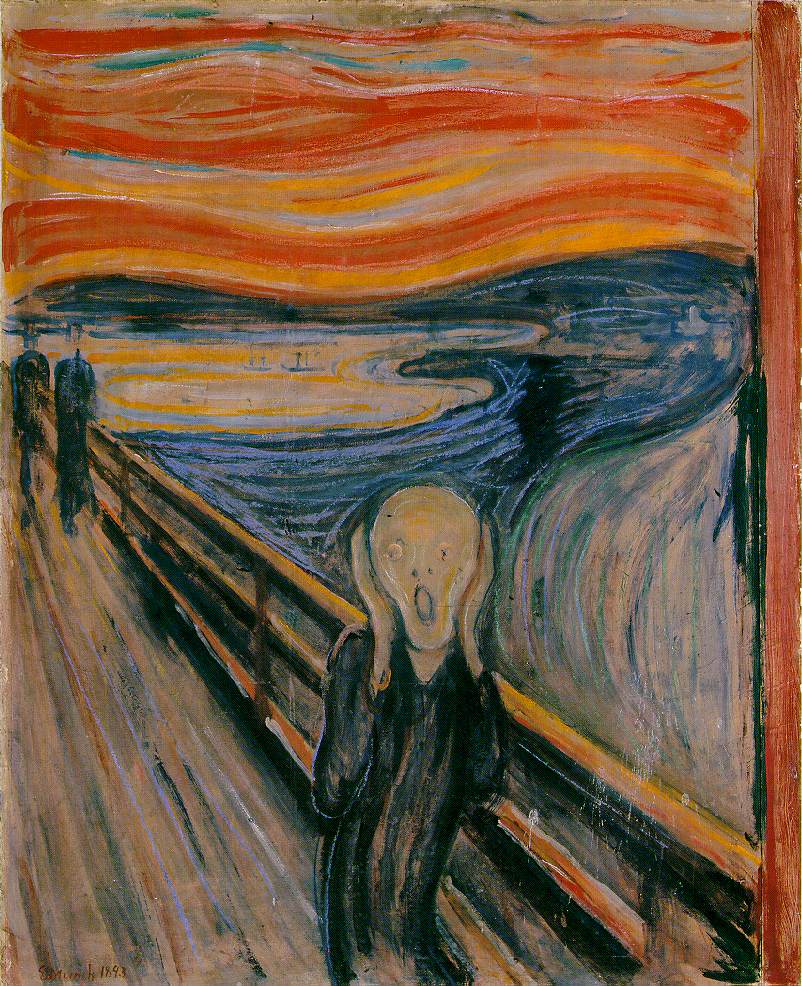
The first stage consists of pondering your current work environment with appropriate horror. Your outlook at this time is bleak, your prospects of survival grim. Like the bald person in Edvard Much's The Scream, or Macauley Culkin from Home Alone, you are mentally slapping both hands to either cheek and howling into the wilderness.

"Oh, God, why do I work here? Whyyyyy?"

Stage 2: Panic 
(minimum two months)

The second stage is characterized by mass confusion and the bloody loss of innocence. Like the innocent folk in Peter Paul Ruben's Massacre of the Innocents, the job hunter wrestles with the demons of panic ("Help! Help!"), hysteria ("I'll never get out of this hellhole!"), and delusion ("I'm sure no one knows I'm job hunting like a maniac!"). In the process, self-confidence and self-esteem are ground underfoot. As a result, the job hunter blindly sends out a ridiculous number of resumes to any and all prospects. This stage is a very low point in the job hunting process.

"AAAHHH!!!"


Stage 3: Panic Some More
(minimum one month)

Larger external factors come into play during the third stage. This is when the job hunter realizes that the average unemployment rate is 9%, meaning competition for ordinary jobs is fiercer than usual, and obtaining a choice position at a top company requires excellent contacts, a brilliant resume, aggressive self-promotion, AND divine intervention. Meanwhile, a bunch of projects are waiting for you at your current job. During this stage, you continue to compulsively send out random applications. The suffering at this stage is an infinitesimal simulacrum of the pain depicted in Picasso's Guernica. 

"Doom! DOOOOM!!!"


Stage 4: Reach Out
(minimum two weeks)

The fourth stage sees a slowdown in resume submission, as the job hunter finally takes some time to do the obvious thing: ask around for advice. The job hunter is told to apply only to positions where he/she stands half a chance, to create compelling and crafted cover letters and/or resumes, to invest in at least one power suit, and to calm the eff down, the world isn't ending and you'll get a new job one day, promise. In Michelangelo's seminal The Creation of Adam, we see the job hunter reclining in mortal ignorance, and the advice-givers represented by God, being carried by cherubs in a billowing cloth/holy carpet. Eve is under Adam, apparently waiting for her boobs to grow in. This is an allegory for the latent maturity that each job hunter will achieve in the later stages.

"Is that you, God? It's me, Adam. I need job hunting advice."


Stage 5: Smile
(variable)

The penultimate stage is when the ball gets rolling and doesn't stop until it sinks into hole called NEW JOB, left corner pocket. This stage requires following all the advice dispensed in the previous stage, luck, and solid interviewing skills. During this time, the job hunter is called for a set of first-round interviews. Afterwards, there are second-round interviews. At this point, the job hunter may or may not invest in a second power suit, if she/he hasn't yet. If sufficient time has passed between the first and second interviews, the same suit may be worn. Rejections will keep pouring in from other places, but the job hunter's serene smile will remain because a second interview means a 50% chance of landing fresh employment!

"I'm almost there. FTW!"


Stage 6: Freeze Up
(variable)

After the inevitable giggling/cackling fit that immediately follows a job offer, the job hunter then realizes that he/she will start all over again in a new place, with new responsibilities, higher expectations, and unfamiliar office dynamics. This does not prevent the job hunter from landing on the new opportunity with both feet and an extra leg just in case, but he/she will tend to be vague and unfocused during the final two weeks at the current job. The job hunter is now no longer a job hunter, but a new hire. The twin prospects of an unknown future and a different company freezes the new hire into a granite block with a rictus smile, like Woman III by Willem de Kooning.

"Yay! ...EEK!" *freeze*

Graphical Analysis:
The graph below represents the growth of the job hunter's self-esteem, self-confidence, and general happiness (x-axis) as time (y-axis, units variable, e.g. months/weeks) passes:


As indicated above, self-esteem, self-confidence, and happiness begin at a low point, and remain at low points even with the passage of time. However, these metrics experience a jump once stage 4 is reached, and continues to rise through the next stages, until the final stage is nearly off the graph. 

It is absolutely crucial that the job offer accepted is at a workplace that is healthy, secure, and stable in order to avoid having the graph reset to stage 1. New hires are advised to keep a low profile in the early weeks, and then balance shining efficiency with ninja-like skills of disappearance, should a promotion or pay raise be desired. But that's another blog post entirely.

~0~

Update, 1/4/2012: AHAHAHA that graph is so wrong! Stages 2 and 3 should be lower on the x-axis. My apologies, ducklings.